Annual Mercury
  Annual Mercury
Bird's-Nest Orchid
  Bird's-Nest Orchid
Black Bindweed
  Black Bindweed
Black Medick
  Black Medick
Blue Bugle
  Blue Bugle
Blue Fleabane
  Blue Fleabane
Bristly Ox-Tongue
  Bristly Ox-Tongue
Broadleaf Plantain
  Broadleaf Plantain
Bush Vetch
  Bush Vetch
Buddleia
  Buddleia
Canadian Goldenrod
  Canadian Goldenrod
Cat's Ear
  Cat's Ear
Wild Chamomile
  Wild Chamomile
Common Chickweed
  Common Chickweed
Wild Chicory
  Wild Chicory
Clustered Bellflower
  Clustered Bellflower
Common Centaury
  Common Centaury
Common Fiddleneck
  Common Fiddleneck
Common Mallow
  Common Mallow
Mouse-Ear Chickweed
  Mouse-Ear Chickweed
Common Orache
  Common Orache
Common Ragwort
  Common Ragwort
Common Toadflax
  Common Toadflax
Wall Speedwell
  Wall Speedwell
Creeping Thistle
  Creeping Thistle
Common Daisy
  Common Daisy
Common Dandelion
  Common Dandelion
Dwarf Gorse
  Dwarf Gorse
Eyebright
  Eyebright
Fat Hen
  Fat Hen
Field Poppy
  Field Poppy
Field Scabious
  Field Scabious
Wood Forget-Me-Not
  Wood Forget-Me-Not
Common Fumitory
  Common Fumitory
Common Hogweed
  Common Hogweed
Greater Celandine
  Greater Celandine
Common Groundsel
  Common Groundsel
Harebell
  Harebell
Common Hedge Mustard
  Common Hedge Mustard
Hedge Woundwort
  Hedge Woundwort
Hedgerow Cranesbill
  Hedgerow Cranesbill
Herb Robert
  Herb Robert
Himalayan Balsam
  Himalayan Balsam
Ivy-Leaved Toadflax
  Ivy-Leaved Toadflax
Common Knotweed
  Common Knotweed
Common Heather
  Common Heather
Montbretia
  Montbretia
Nipplewort
  Nipplewort
Oregon Grape
  Oregon Grape
Oxford Ragwort
  Oxford Ragwort
Pineapple Mayweed
  Pineapple Mayweed
Pink Sorrel
  Pink Sorrel
Prickly Sow Thistle
  Prickly Sow Thistle
Red Bistort
  Red Bistort
Red Dead-Nettle
  Red Dead-Nettle
Red Valerian
  Red Valerian
Ribwort Plantain
  Ribwort Plantain
Rough Hawkbit
  Rough Hawkbit
Scarlet Pimpernel
  Scarlet Pimpernel
Common Selfheal
  Common Selfheal
Shepherd's Purse
  Shepherd's Purse
Small Scabious
  Small Scabious
Small Toadflax
  Small Toadflax
Smooth Sow Thistle
  Smooth Sow Thistle
Tansy
  Tansy
Thyme-Leaved Speedwell
  Thyme-Leaved Speedwell
Watercress
  Watercress
White Campion
  White Campion
White Dead-Nettle
  White Dead-Nettle
Common Yarrow
  Common Yarrow
Wood Avens
  Wood Avens
Yellow Corydalis
  Yellow Corydalis
Yellow-Wort
  Yellow-Wort
Hairy Bittercress
  Hairy Bittercress
Petty Spurge
  Petty Spurge
Field Speedwell
  Field Speedwell
Sea Thrift
  Sea Thrift
Sun Spurge
  Sun Spurge
Pellitory-of-the-Wall
  Pellitory-of-the-Wall
Bee Orchid flower

 Filters: 


Common Hop Humulus lupulus 


Wildlife GardenWildlife garden plant
Attracts ButterfliesButterflies are attracted to this plant
Attracts MothsMoths are attracted to this plant
Attracts BirdsBirds are attracted to this plant
Perennial Life CyclePerennial life cycle
Cup-Shaped FlowersCup-shaped flowers
Cream FlowersCream flowers
5 Petals5 petals
Jul-Sep Flowering
period
Lobed LeavesLobed leaves
Forwardly-Toothed LeavesForwardly-toothed leaves
Angular StemAngular stem
Tap RootTap root
500cmMaximum height
 
 
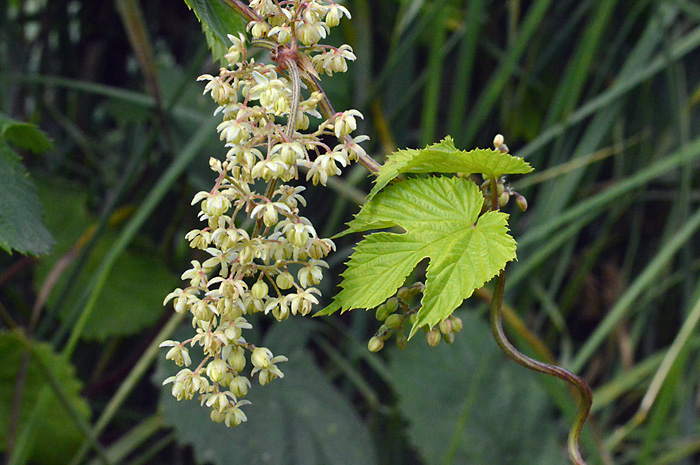
  Main image of Common Hop

© 2020-2025 Adrian Briggs


Common Hop is a native perennial plant of the UK, typically found growing in woodland and hedgerows, to a mature height of up to 500cm.

The Common Hop is a woody climber that has male and female flowers, which grow on separate plants. Male flowers have five cream-coloured tepals, whereas the female flowers are in catkins and less conspicuous. Fertilisation takes place by wind pollination. The hop cones that are used in brewing are formed from the catkins, following pollination.

Botanic classification and naming: Common Hop is a member of the Hemp (Cannabaceae) family. The genus name 'Humulus' identifies the plant as a Hop and its species name 'lupulus' means 'hop plant'.

Benefits: Provides nectar for insects, shelter for birds and a food source for caterpillars of the Comma butterfly and several moth species. It also attracts the Red Admiral butterfly.

Benefits to wildlife are also indicated with orange icons in the plant profile bar at the top.


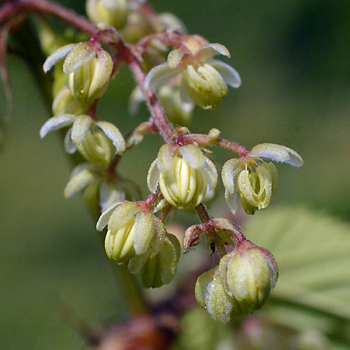
Flower of Common Hop

© 2021 Adrian Briggs


Flowers:
Common Hop usually flowers between July and September.

Flower colour:

Flower Colour Cream

Cream

Flower shape:

Flower Shape  Cup

Cup

Petals:

Petal Number =  5

5

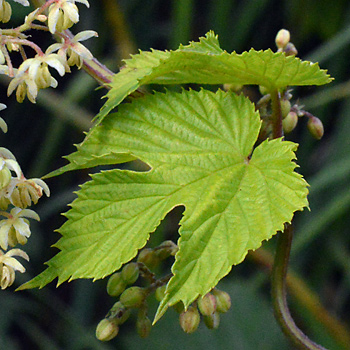
Leaf of Common Hop

© 2021 Adrian Briggs


Leaves:

Leaf Shape:

Leaf Shape is Lobed

Lobed

Or:

Alternative Leaf Shape is Divided

Divided

Leaf Margins:

Leaf Margin is forwardly-toothed

forwardly-toothed

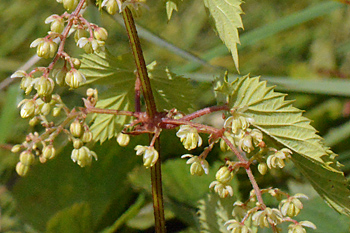
Stem of Common Hop

© 2021 Adrian Briggs


Stem and Roots:

Stem shape:

Stem Shape is Angular

Angular

Root type:

Root Type is Tap

Tap