Annual Mercury
  Annual Mercury
Bird's-Nest Orchid
  Bird's-Nest Orchid
Blue Fleabane
  Blue Fleabane
Bristly Ox-Tongue
  Bristly Ox-Tongue
Bush Vetch
  Bush Vetch
Common Chickweed
  Common Chickweed
Common Ragwort
  Common Ragwort
Common Toadflax
  Common Toadflax
Common Daisy
  Common Daisy
Common Dandelion
  Common Dandelion
Common Hogweed
  Common Hogweed
Common Gorse
  Common Gorse
Common Groundsel
  Common Groundsel
Common Knotweed
  Common Knotweed
Oxford Ragwort
  Oxford Ragwort
Pineapple Mayweed
  Pineapple Mayweed
Prickly Sow Thistle
  Prickly Sow Thistle
Shepherd's Purse
  Shepherd's Purse
Smooth Sow Thistle
  Smooth Sow Thistle
Wood Avens
  Wood Avens
Yellow-Wort
  Yellow-Wort
Hairy Bittercress
  Hairy Bittercress
Field Speedwell
  Field Speedwell
Bee Orchid flower

 Filters: 


Viper's Bugloss Echium vulgare 


Wildlife GardenWildlife garden plant
Attracts BeesBees are attracted to this plant
Attracts ButterfliesButterflies are attracted to this plant
Biennial Life CycleBiennial life cycle
Funnel-Shaped FlowersFunnel-shaped flowers
Blue FlowersBlue flowers
1 Petal1 petal
Jun-Sep Flowering
period
Elongated LeavesElongated leaves
Crinkly-Edged LeavesCrinkly-edged leaves
Round StemRound stem
Tap RootTap root
80cmMaximum height
 
 
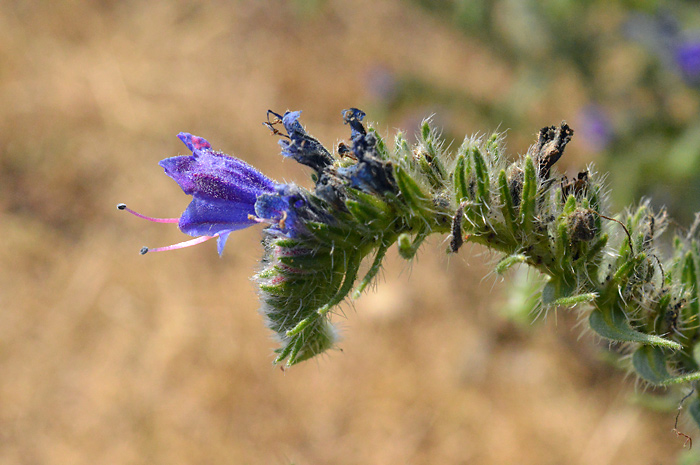
  Main image of Viper's Bugloss

© 2020-2025 Adrian Briggs


Viper's Bugloss is a native biennial plant of the UK, typically found growing in grassland, chalky ground and waste ground, to a mature height of up to 80cm.

Viper's Bugloss is thought to be named 'Viper' after its stem patterning or flower shape, and 'Bugloss' from the Greek for 'Ox tongue', describing the rough texture and shape of its leaves.

Botanic classification and naming: Viper's Bugloss is a member of the Borage (Boraginaceae) family. The genus name 'Echium' identifies the plant as a Viper's Bugloss and its species name 'vulgare' means 'common species'.

Concerns: Viper's Bugloss is toxic to humans and horses, if ingested. The bristles may also cause skin irritation.

Benefits: Attracts Honey bees and the Painted Lady and Large Skipper butterflies.

Benefits to wildlife are also indicated with orange icons in the plant profile bar at the top.


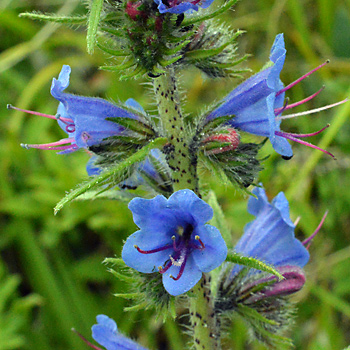
Flower of Viper's Bugloss

© 2021 Adrian Briggs


Flowers:
Viper's Bugloss usually flowers between June and September.

Flower colour:

Flower Colour Blue

Blue

Flower shape:

Flower Shape  Funnel

Funnel

Petals:

Petal Number =  1

1

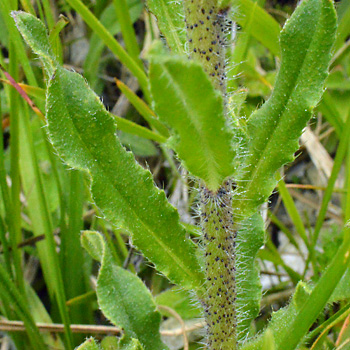
Leaf of Viper's Bugloss

© 2021 Adrian Briggs


Leaves:

Leaf Shape:

Leaf Shape is Elongated

Elongated

Or:

Alternative Leaf Shape is Oval

Oval

Leaf Margins:

Leaf Margin is crinkly-edged

crinkly-edged

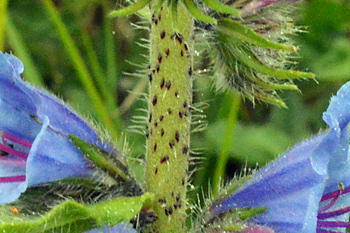
Stem of Viper's Bugloss

© 2021 Adrian Briggs


Stem and Roots:

Stem shape:

Stem Shape is Round

Round

Root type:

Root Type is Tap

Tap